← Amit Patole · Case study
Forge, and the
Observatory built for it.
A multi-agent system that builds what someone asks for in their public repository: it reads the codebase, plans the change, writes the code, tests it in a sandbox and reviews it, then hands the finished work over as a pull request they can merge — and the observability layer that makes every one of those steps visible down to the token.
Status
Built and unit-tested end to end; the first submission window opens 19 September 2026. Each stage has been exercised live on the build machine, but a full cycle against a live repository has not run yet, so no pull requests have shipped. Everything below describes what is built and verified, not what is promised.
The problem
Coding agents are easy to demo and hard to trust. The failure is rarely the model writing bad code; it is that nothing independent ever checks the work before it reaches someone else's repository. A pipeline “succeeded.” A test “passed.” Neither means the change is correct, safe, or wanted.
Forge is the engineering answer to a question I keep returning to: when a model produces an output, what does it actually mean for the work to be done? Its rule is that nothing is published until a grader returns a verdict — and that the graders are not the agent that did the work.
How it works
Requests arrive through a small public site. Ownership is proven by committing a token file to the repository's default branch, so nobody can commission work on someone else's code. Work runs in two-week cycles: one week open for submissions, rated nightly on a public board, then one week of building the winners.
Selection: two independent judges, unanimous
A deterministic gatekeeper runs first, because the cheapest filter should never need a model: intake re-checks, repository state, account age, ownership proof. Then two policy judges from different model families — gpt-oss:120b and qwen3.5:397b — must both approve, against a strict global ethical standard, with a high floor on safety and ethics scores. The model's own allowed flag is never trusted on its own; every condition is re-checked in code. Ranking the survivors is plain Python, not a model.
Build: a bounded repair loop with escalation
A planner (qwen3.5:397b) writes an implementation brief. qwen3-coder:30b runs locally for the volume coding work, because a 30B mixture-of-experts model activates only a few billion parameters per token and fits where a dense model of that size would not; repairs escalate to kimi-k2.7-code in the cloud. Then three checks run in a deliberate order: the tests we run ourselves (never the coder's claim), deterministic diff guardrails (so a model never gets to wave through a hard rule), and only then a reviewer from a different model family than the coder (glm-5.3). Each check returns the same report shape, so the graph routes on one field, the coder receives one kind of feedback, and a repeated failure signature stops the loop instead of burning quota on a stuck agent.
Publishing — fork, commit, push, open the pull request — happens outside the graph, reachable only when it ends in approved. That one structural choice means no bug in the agent logic can publish anything.
Isolation and the trust boundary
Untrusted code runs only inside a locked-down container: no network, all capabilities dropped, read-only root, unprivileged user. Dependency installation is a separate, allowlisted, network-enabled phase that the model never influences. The git directory is kept outside the sandbox mount, so nothing running in the container can plant hooks the host would later execute. Request text, repository contents, model output and test output are all treated as untrusted data that crosses into trusted code only as tagged prompt sections or typed fields.
Where my open-source tools compose
Forge is where the verified-AI family stops being separate libraries and becomes one system. Every check returns an agentsensory report, so the graph has a single contract to route on. Verel grades the tests inside the sandbox and returns attested verdicts. assaylab turns raw failures into root-cause signatures the coder can act on. latenzy measures every model call. Vitel holds the factory itself to SLOs, because “the service is up” is not “the service is working.”
The Observatory
Latency metrics and a log file answer neither of the questions that actually matter when an agent run goes wrong: why did this specific run do that? and what would have happened if it hadn't? So I built an observability layer for Forge designed around a single image: looking at the system the way a being from a fourth dimension would look at a human — every layer at once, and the ability to drill down to the smallest part while it is still moving.
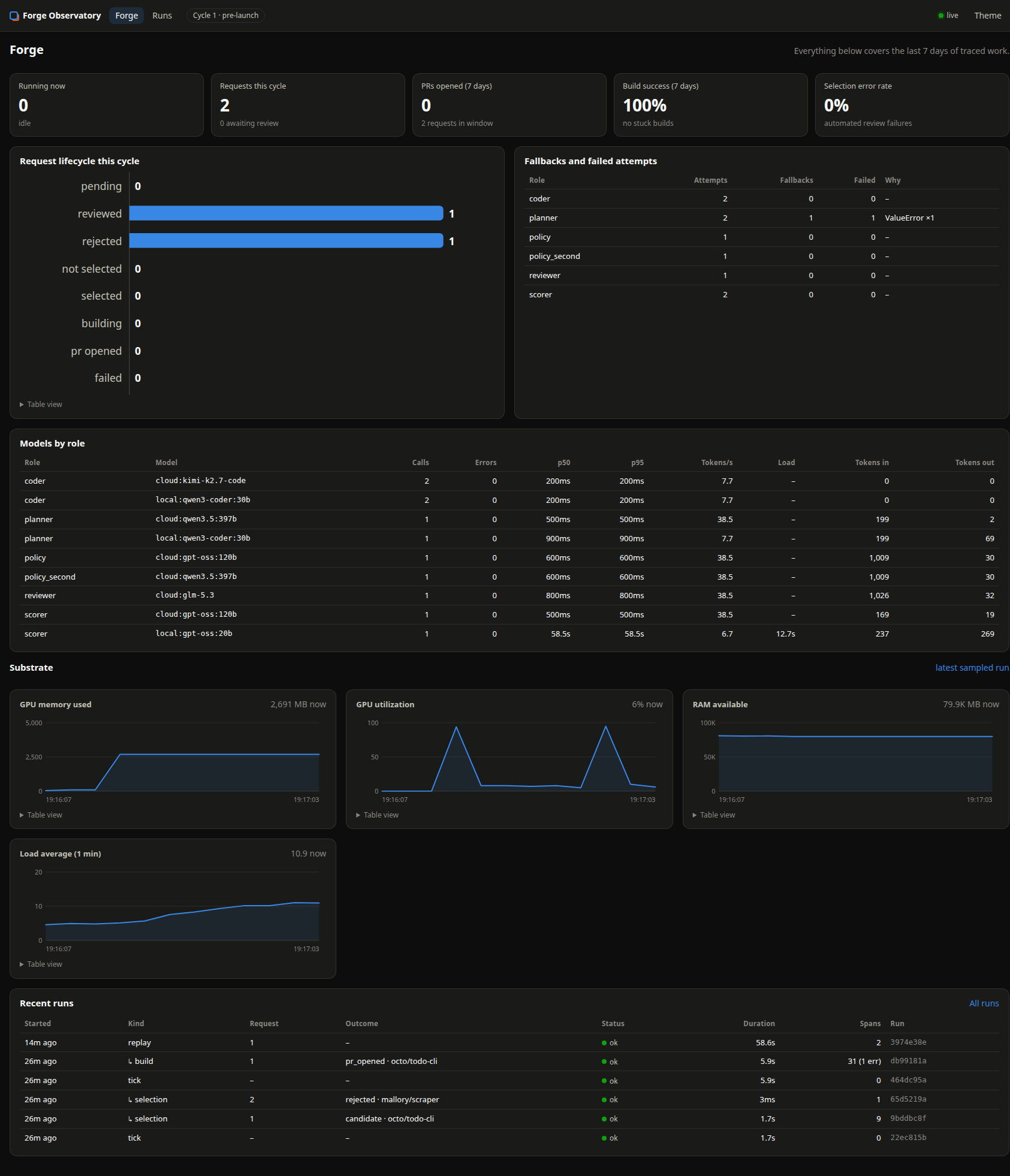
Measured on the build machine rather than estimated: one scorer call on a local 20B model recorded 328 prompt tokens in and 206 out at 7.7 tokens per second, with 12.4 seconds of model load time and 2.2 GB of the 4 GB card in use. Re-running one recorded hosted gpt-oss:120b scorer call as a fork, on the local 20B model instead, took 58.6 seconds at 6.7 tokens per second — and returned a score of 9 where the recorded call had returned 8. That is the point of forking: the disagreement is visible, side by side, on identical input.
Three things it does that logs cannot
Causality threads
Every node's state is recorded key by key, content-addressed so an identical value is stored once. Click any output and the trail runs backwards through every value that produced it: this review saw that diff, which came from that guard, after that test report. “Why did the reviewer approve this?” stops being archaeology.
Prompt anatomy
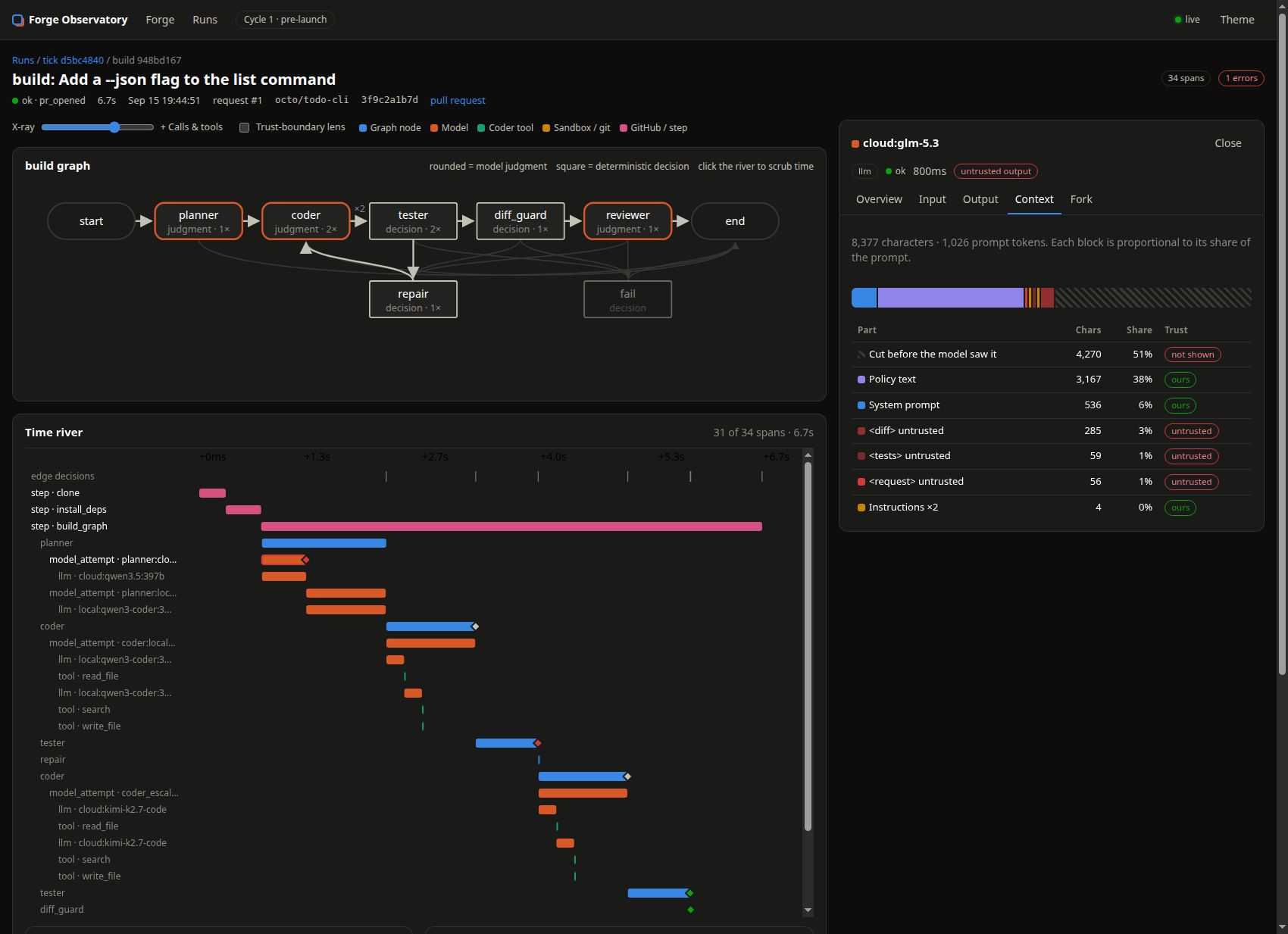
The prompt is rendered as proportional blocks — system, policy text, schema guide, and each untrusted section — with what truncation cut off drawn as a hatched gap. On a real build it read: 51% of the diff, never seen by the model. That blind spot had existed for weeks and was invisible in every log.
Forking a recorded call
Any captured model call can be re-run against a different model, with edited messages, side by side with the original. Because publishing lives outside the graph, a fork is only a model call — it cannot touch a workspace, git, or GitHub. Debugging becomes experimenting.
A bug it found immediately
Instrumenting the GitHub client surfaced an ownership check that always raised, because one argument was passed twice. Unit tests never caught it: they mocked that function. In production it would have failed every verification, silently, on the one gate that proves a requester owns the repository.
Design decisions worth naming
- Replay-grade capture, not sampling. Re-running a node requires its complete inputs, so prompts, responses, tool arguments, command output and per-round workspace diffs are all stored, deduplicated by content hash, with a retention window.
- Every fallback attempt is its own span. When a model returns output that fails schema validation and the next model quietly succeeds, the failure still appears, with its error type. Silent recovery is how you lose weeks.
- Telemetry may never break the work. Every write swallows its own errors; a broken trace store cannot fail a build, and there is a test that proves it.
- Secrets are redacted before anything is written — tokens, keys, their encoded forms, and the push auth header, which is never recorded at all. Tests scan the raw database files to confirm.
- The dashboard is local-only by construction. It binds to loopback with no option to bind anything else, refuses any request whose Host is not loopback, requires a custom header plus a local origin on every write, and serves a strict CSP. It displays attacker-controlled text, so it is treated as an injection target itself: the interface builds DOM with text nodes only.
- No build step, no dependencies, no CDN. The interface is hand-written ES modules and SVG, which is what lets the content policy be that strict and the whole thing run offline.
Stack
| Concern | Approach |
|---|---|
| Orchestration | LangGraph state machines; deterministic routing functions over typed agent output |
| Agents | Five specialized roles — policy, scorer, planner, coder, reviewer — each with one job and one typed schema |
| Model routing | Role-based: qwen3-coder:30b locally for volume; hosted gpt-oss:120b, qwen3.5:397b, kimi-k2.7-code and glm-5.3 for judgment, planning and repairs — each role with a fallback that fires on error, quota, or output that fails schema validation |
| Isolation | Docker with no network, dropped capabilities, read-only root, unprivileged user |
| Verification | Verel attested test verdicts, assaylab root-cause signatures, agentsensory report contract, Vitel SLOs |
| Observability | Purpose-built trace store in SQLite, LangChain callbacks, graph wrappers, a local dashboard, latenzy metrics |
| Operations | SQLite with WAL, systemd timer, tunnel-only exposure, no open ports |
| Hardware | One laptop with a 4 GB GPU, serving local models through Ollama, with Ollama Cloud for the larger judgment models |
What is verified, and what is not
Unit tests cover every route through both graphs with the agents faked out: the happy path, escalation, bounded repair, stall detection, the guardrail blocking before review, reviewer feedback returning to the coder, a security veto, planner refusal, ranking, policy rejection and injection flags. The observability layer has its own suite covering span nesting, secret redaction, causality, the security guards, forking, and the promise that a broken trace store cannot break a build.
Verified live on the build machine: typed output from local models, an attested test failure followed by a pass inside the sandbox, a root-cause signature from a real failure, blocked network egress from the container, recorded per-model latency, SLO grading, and a fork of a recorded call re-run against a local model. Not yet run: a full cycle end to end against a live repository, which needs the first submission window to open.
The design record behind all of this runs to fifty-one numbered decisions, each with its rationale, the alternatives considered, and the trade-off accepted. The repository is private; I am happy to walk through the architecture, the decision record, or the observability layer in detail.