Verel — Verified Agents 👁️🧠

Problem: AI agents declare work "done" on their own say-so — shipping broken UIs, failing tests and unverified claims they can't actually check. Result: Verel makes "done" a verdict, not an opinion — every action is graded by real senses (including eyes, via AgentVision), and only verified work compounds into the fleet's shared memory.
pip install verel
verel doctor                 # check your environment
verel heal --repo .          # self-healing CI: failing tests → agent fixes → green
One verdict bus unifies vision + tests + lint + types into a single pass / warn / fail,
so progress, "done", and what compounds are all decided in one place — with grader
attestation (a signed receipt of what actually ran) so a hollow check — a grader that claims
success with no evidence — can't mint green.
Is Verel for you?
- Agents that write code, and you need a grader that re-runs the real tests so the agent can't fake "done"? → yes. Start: 5-minute tutorial.
- A fleet of agents sharing one brain, where a hallucination (or one bad actor) must not become trusted memory? → yes. Start: Memory in 5 minutes.
- Agents that render UIs but never look at them (overflow, contrast, 404s, video stalls)? → yes, with AgentVision as the eyes.
- Paying too much for context because you replay the whole memory into every prompt? → yes — budgeted, graded-first recall cuts a 40-fact brain ~80% (679→135 tok/turn). Cost →
- Gating agent-authored 5G RAN/Core changes (a slice missing from NSSF, a gNB TAC no AMF serves, a KPI regression)? → yes — deterministic, offline, one rule body grades Helm and NETCONF. Telecom RAN / 5G Core →
- Just want a memory layer for a single agent with a human curator? → Verel works, but Mem0 is simpler. Here's the honest when-to-use comparison.
The seven organs
| Organ | Module | What it does |
|---|---|---|
| 🧠 Brain | verel.memory |
Memory that compounds — only verified facts/skills graduate (held-out, attested promotion gate); lifecycle controls keep it from becoming a junk drawer. Pluggable backend (VEREL_MEMORY_BACKEND): local SQLite, a shared hosted brain, or an external DB. |
| 👁️ Eyes | verel.senses |
AgentVision as a perception organ (DOM/contrast/OCR grounded, intent conformance, temporal watch) feeding the verdict bus and the brain. |
| 🛡️ Immune (ingress) | verel.guard |
Document-ingress guard — scans an untrusted document (docx/pptx/xlsx/odf/pdf/html/rtf/text) for hidden content and prompt injection before an LLM reads it, catching the Copilot "AI worm" class on the visible-vs-extracted mismatch. Fail-closed into memory + an anti-worm propagation check. → Guard |
| ⚖️ Verdict bus | verel.verdict |
One schema for every sense — advisory ceiling clamp, grader attestation, strict-subset stuck/progress. |
| 🚁 Fleet | verel.fleet |
Agents managing agents — LLM manager fans out, workers in isolated git worktrees, each gated by the bus. |
| 🔧 Tool-smith | verel.toolsmith |
Agents build their own tools, sandboxed, admitted only on a passing attested eval. |
| ♻️ Agent-run CI/CD | verel.ci |
Self-healing pipeline + deterministic rollback that never acts on advisory evidence; graders span Python/JS-TS/Go, perf, security, mutation, spec/intent — and IaC / cloud-IAM / Kubernetes-RBAC (catch dangerous Terraform/cloud grants before apply). |
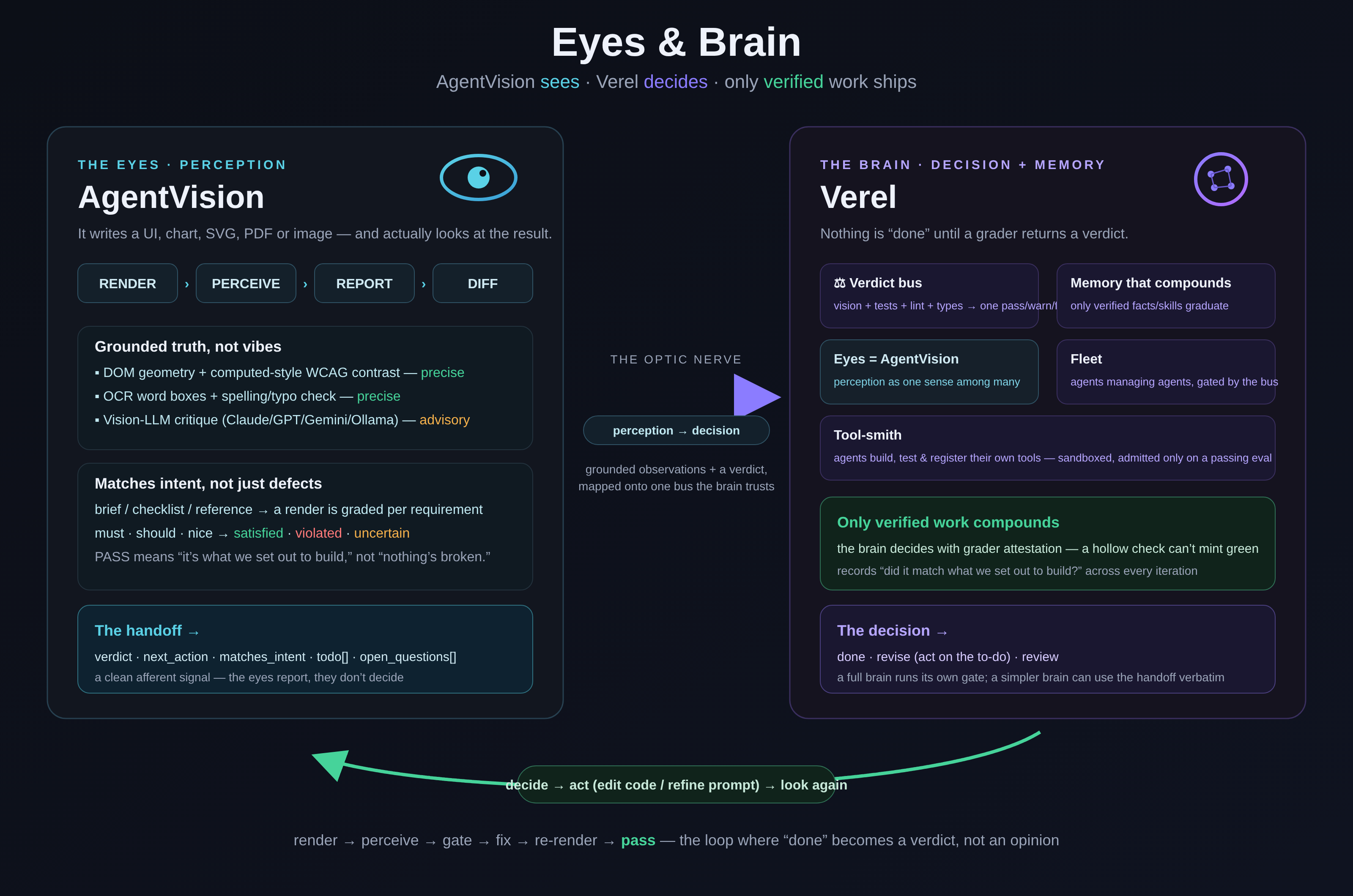
Eyes & brain
AgentVision is the eyes; Verel is the brain. The eyes perceive and grade (including does it match what we set out to build? and does the video actually play?); the brain decides with attestation and compounds only verified work into memory; then the eyes look again.
Next
- Memory in 5 minutes — extract → grade → recall, offline, no key. The fastest standalone win if you came for the memory.
- Verel vs Mem0 / Engram / Zep — honest when-to-use, and a "coming from Mem0" mapping.
- Try it yourself — a from-scratch, copy-paste walkthrough (no API key): catch a real bug, fix it, watch Verel remember it so it can't come back.
- Start here — zero to your first verdict in two minutes; the one core idea.
- Get started — install, the gate, CI/agents adoption.
- Install & extras — the light base wheel + every optional extra, and when to use it.
- Trust model — what's cryptographically guaranteed (signed receipts, isolation) and what isn't.
- 5-minute tutorial — gate a repo, heal failing tests, watch a bug get remembered.
- Use cases — where Verel fits: agent loops, CI/CD, fleets, shared memory.
- Real-world scenarios — runnable demos with real captured output for each.
- Architecture — the seven organs and the eval-driven loop.
Install: pip install verel · Source: GitHub ·
Package: PyPI · License: MIT.