Verel — Architecture & Roadmap¶
Verel is an agent framework built on one idea: every agent action is a hypothesis, and
nothing is "done" until a grader returns a verdict. A single verdict bus unifies every
kind of check — vision, tests, lint, types — into one pass / warn / fail, so progress,
"done", and what compounds into memory are all decided in one place.
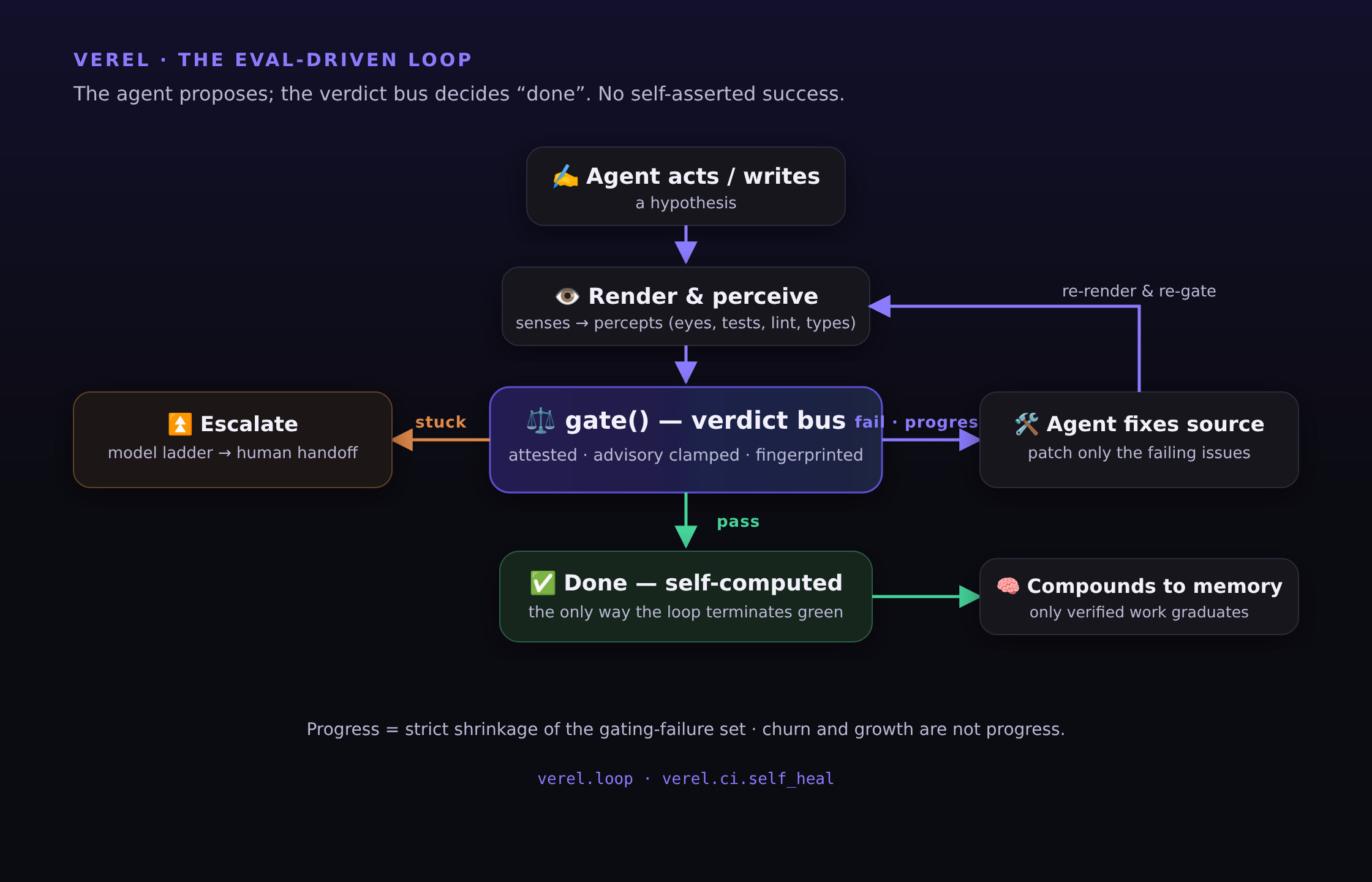
This document describes how the pieces fit together and where the project is going. For the exact module layout see the module guide; for the release history see the changelog.
The six organs¶
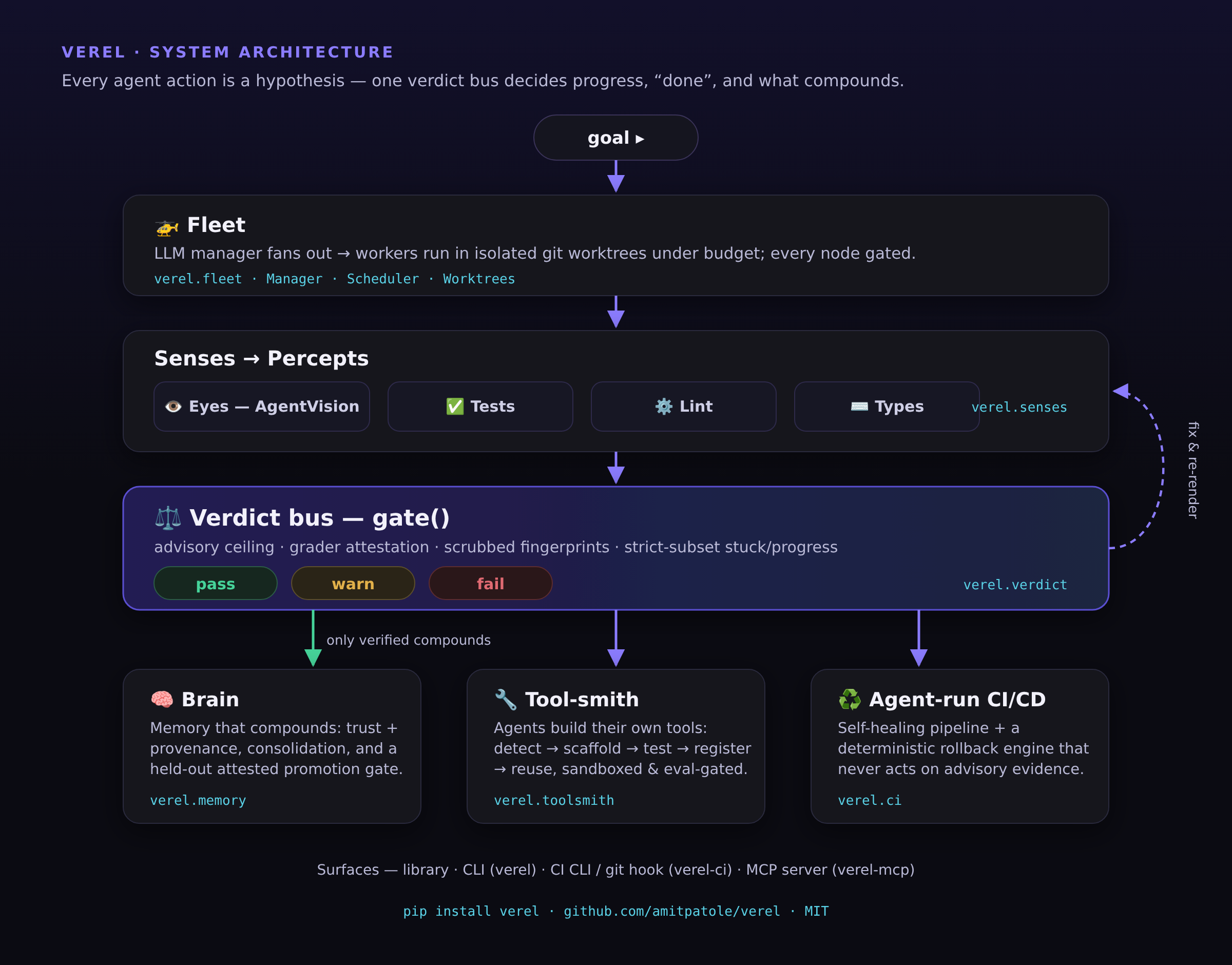
| Organ | Module | Responsibility |
|---|---|---|
| Verdict bus | verel.verdict |
One Report/Percept schema for every sense; gate() reduces them to a verdict. |
| Eyes / Senses | verel.senses |
AgentVision as a grounded perception adapter, plus the percept log. |
| Brain | verel.memory |
The trust layer over a memory backend: what is believed, how strongly, and what compounds. |
| Fleet | verel.fleet |
Agents managing agents — manager fan-out, scheduler, isolated worktrees. |
| Tool-smith | verel.toolsmith |
Agents building, testing, and registering their own tools. |
| Agent-run CI/CD | verel.ci |
Graders, staged pipeline, self-healing, and verdict-driven rollback. |
The verdict bus (verel.verdict)¶
Every grader emits a Report of Issues with a verdict. gate() reduces a set of reports
to a single verdict under a few load-bearing rules:
- Advisory ceiling. Per-issue trust keys off the issue source. Precise sources
(DOM / CV / OCR / test / lint / typecheck) gate at full severity; advisory sources
(vision / LLM-judge) are clamped to at most
warn. An advisory opinion never gates a hard failure. - Grader attestation. A required grader must present a signed
run_receiptproving it ran the frozen suite over the changed files. A hollowPASS, issues=[]with no receipt fails the gate — "present-but-empty" can't mint green. - Scrubbed fingerprints. Each issue gets a stable, normalized fingerprint (line numbers, addresses, timestamps, floats scrubbed) so the same logical failure hashes identically across runs — which is what makes stuck-detection reliable.
- Stuck vs. progress. Progress is defined as strict shrinkage of the gating-failure set. Pure churn or growth is not progress; a new gating issue is a regression.
The Brain — memory that compounds (verel.memory)¶
Memory is state stored outside the model and selectively re-injected. Verel owns the trust
layer over a pluggable backend behind a single MemoryView protocol. A backend is selected by
name (VEREL_MEMORY_BACKEND) through a registry: built-in local (zero-dependency SQLite) and
remote (a shared hosted brain over HTTP(S)), plus external databases (Postgres/pgvector, LanceDB,
Redis) shipped as pip install verel[<db>] extras — and third parties can register their own via the
verel.memory_backends entry-point group. Because every backend implements the same MemoryView
contract, everything below (consolidation, the promotion gate, replication, the failure ledger) works
unchanged whichever store is selected; the store provides relevance, Verel owns the ranking and trust.
Each record carries two orthogonal quantities, never collapsed into one:
- epistemic_confidence — how true we believe it is. Moved only by corroboration (+) and
contradiction (−). Retrieval never touches it.
- retrieval_strength — how reachable it is. Decays with disuse, resets on recall. The decay is
adaptive: a memory's effective half-life stretches with demonstrated usefulness
(support_count + epistemic_confidence), so a corroborated rule outlives a one-off — tuning
of reachability only, never of truth.
On top of that:
- Interference rule — a new value for the same (subject, predicate, scope) supersedes
rather than silently duplicating.
- Consolidation — an offline pass clusters recurring failures (by kind, or by meaning with
an embedder) and induces a candidate structured DesignRule (condition → action,
applies_to). induce_hierarchy then climbs a multi-hop SCHEMA ladder — rules → order-2
principles → order-3 meta-principles — until the corpus stops supporting a higher level, so the
top is the most general principle the evidence backs. consolidate_across_scopes lifts a pattern
that recurs across several repos into a global rule (and refuses a single-repo quirk). All
start inferred; height and breadth never confer trust.
- Contradiction-driven revision (revise_with_counterexample) — consolidation can also be
wrong. A new failure in a rule's domain that the rule failed to prevent is a counterexample:
it's recorded (via annotate, no corroboration), the rule is contradicted, and once enough
counterexamples accumulate the rule is split into a narrowed general rule (which supersedes
the original) plus a specific exception rule — or, if belief collapses, rejected. A split then
propagates up (propagate_revision): every SCHEMA that subsumed the rule is re-derived
from its now-revised members and reset to candidate, climbing the hierarchy, so a corrected
leaf never leaves an over-claiming principle above it. Revision only ever lowers trust or narrows
scope.
- Promotion gate — a candidate reaches verified only by passing a held-out,
agent-inaccessible eval (with a leakage canary). Trust is earned, never asserted.
- Failure ledger + regression guard — past gating failures are remembered; reintroducing
a previously-fixed failure fails the gate from memory alone.
- Scope lattice (self → team → org → global) — the spine of a shared brain.
lattice_recall resolves down: an agent recalls across its own, its team's, and its org's
knowledge at once, with the most-specific scope winning ties. graduate promotes up: a belief
independently verified across sibling scopes becomes a parent-level candidate that must re-earn
verified — collective knowledge no single agent decreed. Individual and collective memory are
the same machinery at different radii of the lattice.
- Hosted shared memory (MemoryServer / RemoteMemory) — for a fleet on different machines,
a durable MemoryView behind a tiny HTTP service. RemoteMemory implements the same Protocol, so
lattice_recall, graduate, consolidation, and the promotion gate all run against the shared
brain unchanged. The server is the single writer — every access is lock-serialized, so the
interference rule stays correct under concurrent agents.
- Replicated, HA memory (ReplicatedMemory) — for no single point of failure, the store runs
as a leader-fenced, fault-tolerant cluster. Exactly one node is leader (held by a fencing
lease — the same monotonic-token primitive the fleet uses); the leader applies every mutation
locally and replicates the resulting record state verbatim (so replication is idempotent) to
its peers. Replication tolerates failure: an unreachable follower does not fail the write (it
falls behind and catches up via sync_from), and a write_quorum sets how many nodes must hold a
write to call it durable. A deposed leader is fenced (NotLeaderError on write, FencingError on
a stale in-flight replicate) — no split-brain. Reads are served from any node's replica
(eventual consistency). The lease store (the hosted control plane across machines) is the single
source of fencing truth; ReplicaClient carries replication to follower MemoryServers over HTTP.
A node that fell behind self-heals without an operator: the AntiEntropy reconciler periodically
resolves the current leader (via the lease store's holder) and sync_froms it in the background.
On-disk stores are crash-safe: LocalMemory opens WAL with synchronous=FULL, so a commit is
fsync'd before the call returns — an acked write is durable before its replica is even sent, and
survives a leader crash (durable=False relaxes to synchronous=NORMAL for speed where it's ok).
Reads are local (eventual) by default — fast, may lag — or, with read_consistency='strong',
routed to the current leader (the single writer, so it holds every committed write) for
read-your-writes / linearizable-ish reads; it falls back to local if no leader can be resolved.
Strong reads, though, fail when the leader is down. read_consistency='quorum' closes that gap:
the leader stamps every mutation with a monotonic version (token * STRIDE + seq, so versions
increase within a leader and across failovers), and a quorum get polls up to read_quorum
replicas and returns the freshest copy — a point read that survives the leader being down, as
long as a quorum of replicas hold the record. The same versions make replication
reorder-/duplicate-safe: an older-version replicate never clobbers a newer copy (version_of).
- Cross-agent trust — sharing a brain safely. import_belief applies the registry's
"trust does not travel" rule to beliefs: a peer's claim enters as a candidate and only becomes
verified by passing the importer's OWN check (its self-asserted confidence is ignored).
AuthorTrust is a per-author reputation, stored in the brain itself: a contributor whose
beliefs keep re-verifying earns a higher prior (their claims start more believed, surface sooner);
a noisy one's falls. A fresh import's starting confidence is anchored to the author's reputation,
not the peer's assertion — so a single bad actor can't move the collective.
- The librarian (librarian_pass) — the gated maintenance cycle, the brain's "sleep." It
orchestrates primitives that each earn their own trust: consolidate recurring failures into
candidate rules, induce the schema hierarchy, graduate cross-scope beliefs up the lattice, and
prune/decay what §5 allows. Steps that create knowledge write only candidate/inferred records
(they still face the promotion gate); prune never touches a verified or pinned memory. So the
brain compounds without rotting, and the librarian proposes and tidies — it never mints trust.
Runs against any MemoryView, so it maintains the shared team brain too.
- Recall — lexical by default; semantic (cosine) when an embedder is configured.
- Lifecycle controls — pinned memories ignore decay and are never pruned; volatile
memories are kept only if corroborated/verified within a window; a hard ttl_s expires
ephemeral environment facts; idle records are flagged stale; and supersedes keep a
queryable correction chain instead of overwriting history.
The Fleet — agents managing agents (verel.fleet)¶
A control plane over agent execution:
- Manager decomposes a goal into a fan-out of independent subtasks (LLM-driven, with the plane validating and clamping the decision — and falling back safely on bad output).
- Scheduler — runs a Task DAG with barrier policies (
all/k_of_n/optional), a concurrency cap, retry → quarantine, a hard budget lease, and WAL-based crash resume. Every node is gated by the verdict bus, so a worker can't self-declare done. - Concurrent managers — more than one scheduler can share a task store safely via fencing
leases (
lease.py): a lease carries a monotonic token, taking over an expired lease bumps it, and every terminal write is fenced — a stale leader whose token is no longer current is rejected, not allowed to corrupt shared state. Peers adopt each other's recorded outcomes, so each task runs exactly once. Backends: in-memory (one process) or sqlite (BEGIN IMMEDIATE, cross-process). - Git fencing sink — fencing isn't only in the task store: a
pre-receivehook on the remote (fence_sink.py) refuses a push whose token isn't current, so a paused leader can't push stale code over a successor's. The pusher passes(resource, token)as git push options; the hook checks them against the same sqlite store. - Multi-repo coordination —
plan_multi_reponamespaces per-repo tasks and adds cross-repo edges into one DAG, validated acyclic (a cross-repo cycle is rejected up front, never deadlocked). One fenced scheduler then enforces "ship the client only after the API builds". - Cross-repo atomic sagas — a change spanning repos commits as a saga (
saga.py): each step has a forward action and a compensation, and a failure runs the compensations of the already-committed steps in reverse (a safegit revert, never a reset) — all-or-nothing. - Hosted control plane — for managers on different machines (no shared filesystem), the lease
authority is wrapped in a tiny, dependency-free HTTP service (
control_plane.py). The server is the clock authority (so skewed manager clocks can't disagree about expiry); aRemoteLeaseStoreclient speaks the sameLeaseStoreProtocol, soScheduler(leases=RemoteLeaseStore(url))coordinates cross-machine unchanged. Terminal writes are still fenced (a stalecompleteis a 409); an optional bearer token gates access. - Worktrees — each worker runs in its own isolated git worktree with an exclusive advisory lease, so parallel workers never stomp each other.
Tool-smith — agents build their own tools (verel.toolsmith)¶
Lifecycle: detect → scaffold → test → register → reuse. A capability request first tries
reuse (semantic when an embedder is present); if missing, an LLM scaffolds a function, it is
tested against held-out cases, and it is admitted to procedural memory only on a passing,
attested eval. Read-only/idempotent tools auto-verify; destructive tools require a
human-review verdict. Tool code is content-signed and executed under isolation
(isolation="container" uses a bwrap namespace sandbox — no network, read-only fs — plus an
optional seccomp-bpf syscall filter via verel[container], in three profiles: a default denylist;
a default-deny allowlist jail (no network/subprocess/threads); and a per-tool capability jail
that allows only the syscalls a tool exercised while passing its held-out eval, learned via
strace and frozen onto the tool — so a verified tool that later attempts a new syscall is
refused at the kernel).
Agent-run CI/CD (verel.ci)¶
Tests, lint, and types are first-class senses on the same bus — across Python, JS/TS, and Go
(language= on each stage), plus perf and security senses. A GraderSpec carries its own
parser, so pytest, go test -json, and a TAP runner — all GraderKind.TEST — parse by their own
format while sharing one schema, one gate, and one stuck/progress signal. The staged pipeline:
| Stage | What runs |
|---|---|
| inner-loop | lint / typecheck / fast unit on the working tree (per language) |
| pre-commit | unit + affected tests + a failure-memory regression check |
| pre-merge | full suite + lint + types, optionally security (SAST/audit) and a perf budget |
| post-merge / canary | smoke/E2E; on a precise-evidence failure, an automated rollback |
Perf and security are precise graders: a perf regression past an explicit budget, or a
HIGH/CRITICAL security finding, gates (and can drive rollback) — sub-threshold findings only
advise. Language toolchains live in verel.ci.LANGS; adding a runtime is one LangToolchain entry.
- Self-healing — on failure the ci-medic classifies each issue (retry / regen-lockfile / quarantine-flaky / fix-branch) and, for genuine regressions, invokes the code-fixer agent, re-gating every round until the graders pass or it escalates.
- Rollback policy engine — the agent proposes, a deterministic engine authorizes (only
on precise gating evidence) and performs a safe, non-destructive
git revert. A destructive action never depends on advisory evidence.
Surfaces¶
- Library (
import verel) · CLI (verel doctor|loop|fleet|heal|ci) · CI CLI / git hook (verel-ci,python -m verel.ci) · MCP server (verel-mcp).
Default LLM provider is Ollama Cloud; OpenAI is the bundled fallback, and the provider seam in
agents/llm.py makes others (e.g. Claude) a small addition.
Roadmap¶
Done (all six organs, end-to-end): verdict bus with attestation; AgentVision sight
adapter; the memory trust layer with consolidation + promotion gate (LocalMemory and mem0);
semantic recall; the fleet (manager + scheduler + worktrees); the tool-smith with subprocess
and container isolation; the full CI/CD stage table with self-healing and rollback; a
content-addressed skill registry — now hosted over HTTP (RegistryServer/RemoteRegistry),
with a cross-tenant transfer experiment that justified building it; CLI + MCP surfaces.
The project is lint/type-clean, ships type information, and gates its own development through
its own verdict bus in CI.
Next:
- Broaden senses further — Rust/Java toolchains; richer perf harnesses; more SAST backends.
- Consolidation: re-promote a revised schema automatically once its narrowed members re-verify
(today a propagated schema returns to candidate and must earn verified again by hand).
- Distributed hardening — replicate the control-plane store (today a single sqlite host is the
authority); push-time identity (sign the push token to the fencing sink).
- Skill-registry curation — reputation/provenance ranking now that the registry is hosted
(RegistryServer); the two-model H2 sweep (88–89% transfer) justified building it.
- Seccomp profile portability across architectures (the learned policy is x86-64-derived today).
Honest limits¶
- The in-process tool guard is a guardrail, not a sandbox; real isolation is the container runner — namespace isolation (no network, read-only fs) plus a seccomp-bpf syscall filter in three profiles: a default denylist, a default-deny allowlist jail (no network/subprocess/ threads), and a per-tool capability jail allowing only the syscalls a tool earned while verified.
- Advisory (vision/LLM) findings inform but never gate destructive actions.
- Vision-model bounding boxes are advisory, not pixel-accurate; LLM outputs are not deterministic. Verel is explicit about which signals are precise and which are advisory.